Co-design
Geometry and watt distribution
Position, loop geometry, power split, watt distribution and cold zones laid out around your cavity, tub or tank.
How co-design works

Since 1959
Tel. +90 312 814 51 20
WhatsApp +90 533 619 95 45
Email: t@tormec.com.tr
BALÇIK Isı Elemanları Sanayi Ticaret A.Ş.
Fatih Mh. Turgut Özal Blv. No:50
Kahramankazan 06980 Ankara Türkiye
Energy efficiency in element design
A resistive heating element converts practically all of its electrical input into heat – there is no conversion loss left to engineer away. What decides an appliance’s consumption is how much of that heat reaches the water, the food or the air, how fast, and for how long the appliance has to run.
That is where element design matters: surface load, cold zones, sheath surface, position, mass and control. We set each lever with your engineers – and measure the result rather than assume it.
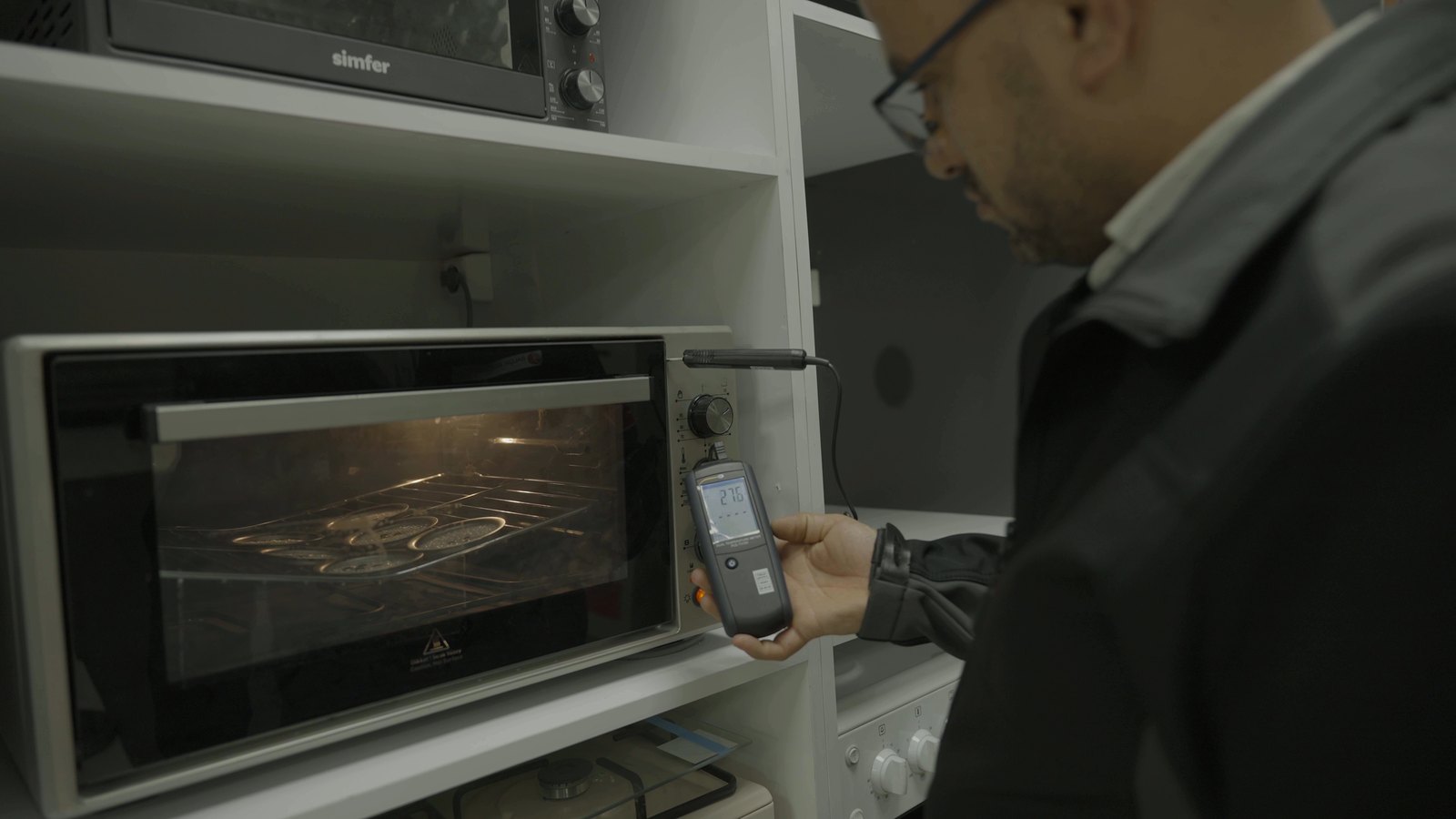 Oven test bench
The energy balance
Electrical input equals heat output. The useful share is the part that reaches the load; the rest is stored in the cavity, tank and element or leaks to the surroundings while the appliance runs.
Six design levers
None of these levers creates heat from nothing. Each one moves heat towards the load, shortens the time to temperature or stops heat from being produced where it is lost.
| Lever | What it changes | How we set it |
|---|---|---|
| Surface load | The sheath temperature in a given medium: in water the speed of scale growth, in air and radiant duty the share of heat that leaves by radiation. | Chosen for the medium, flow and allowed sheath temperature; the final value is validated in our laboratory. |
| Cold zones | Heat produced inside a flange, wall or bracket goes into the structure and heats the terminal seal instead of the load. | Unheated length matched to the mounting, so the whole heated length sits in the medium. |
| Sheath material and emissivity | Radiated power grows with emissivity and with the fourth power of the absolute sheath temperature. In liquids the grade decides corrosion and scale behaviour instead. | Radiant duty: a high-emissivity, oxidised surface. Liquids: a grade that stays clean in your water. |
| Position and geometry | How directly the heat reaches the load: position, distance and view to the load, and how evenly the heat is spread. | Layout around your cavity, tub or tank – loop geometry, power split between elements, watt distribution along the element. |
| Thermal mass | Heat stored in the element and its supports delays heat-up and keeps heating after switch-off – a source of overshoot. | Diameter, length and supports sized for the response the control strategy needs. |
| Control | Set-point accuracy, switching differential and sensor position decide the temperature the appliance actually holds. Overshoot raises losses. | Matched stem thermostats for water heaters; NTC or PT100 sensors at a defined contact position. |
By appliance
Watt density on the heated sheath as listed on our Specifications page; the right column names the design point with the largest effect on energy use.
| Appliance | Watt density | Design point with the largest effect |
|---|---|---|
| Ovens | 5 – 8 W/cm² (radiant duty); up to ≈ 10 W/cm² on fan-oven rings behind a cover | Position and power split of top, bottom and ring elements; radiant surface; heat-up time of the cavity. |
| Washing machines | 5 – 10 W/cm² on double hairpins; compact single hairpins run higher (hard water at the low end) | Heating the wash water is the largest energy use of a warm cycle: an accurately placed NTC keeps the water at the programme temperature, not above it. |
| Storage water heaters | 6 – 12 W/cm² storage heaters (lower in hard water) | Thermostat accuracy and switching differential set the stored temperature and with it the standby losses; an element low in the tank heats the whole volume. |
| Defrost heaters | 1 – 3 W/cm² | Heat that escapes into the cabinet has to be removed again by the compressor: placement close to the evaporator and an even, low load. |
| Finned air heaters | 2 – 4 W/cm² on the tube | Fins multiply the air-side surface: the same power at a lower sheath temperature, so more heat goes into the air stream and less radiates to the housing. |
How we work with you
Co-design
Position, loop geometry, power split, watt distribution and cold zones laid out around your cavity, tub or tank.
How co-design worksControl
BALÇIK TORMEC stem thermostats matched to water-heater elements; NTC or PT100 sensors at a defined contact position.
Stem-type thermostatsValidation
Power, heating uniformity and cold zones checked on samples; ovens tested on benches with temperature and power measurement.
Our validation laboratorySend the appliance data and the test cycle. We review element layout, cold zones and control, and agree with you what to measure.
Engineered and made in Ankara · since 1959
Three generations of know-how, our own welded tube and brazing lines, an engineering team with its validation laboratory and a 100 % electrical test on every element – so the heat inside your product is the one thing you never have to worry about.
How heating element design affects appliance energy use: surface load, cold zones, sheath emissivity, position, thermal mass and control – with tables.
BALÇIK TORMEC designs and manufactures tubular heating elements in Kahramankazan, Ankara, since 1959 – series and custom production to your drawing, VDE-approved element families, ISO 9001:2015, exports to more than 60 countries.
Reception & switchboard
Human resources
Sales – Türkiye
Export sales
Accounting
Purchasing & imports
Production & planning
Quality
We use essential cookies to run the site and, with your consent, functional cookies for language selection and embedded maps. No advertising or profiling cookies are used. See our Cookie Policy and KVKK / privacy notices.
Sitenin çalışması için zorunlu çerezleri; onayınızla dil seçimi ve gömülü harita için işlevsel çerezleri kullanıyoruz. Reklam veya profilleme çerezi kullanılmaz. Çerez Politikası ve KVKK aydınlatma metinleri.