

STF terminal sealing
Moisture enters at the terminal end – where STF works.
Compacted magnesium oxide (MgO) insulates the coil from the sheath only while it is dry, and the open tube ends are its only contact with the air. BALÇIK TORMEC’s STF terminal sealing system keeps moisture out of the MgO – so insulation resistance and leakage current stay stable after long storage and in humid duty.
The risk peaks at first switch-on after weeks in a warehouse or a humid container: a damp element can trip the residual-current device (RCD), although it passed every test when it left the factory.
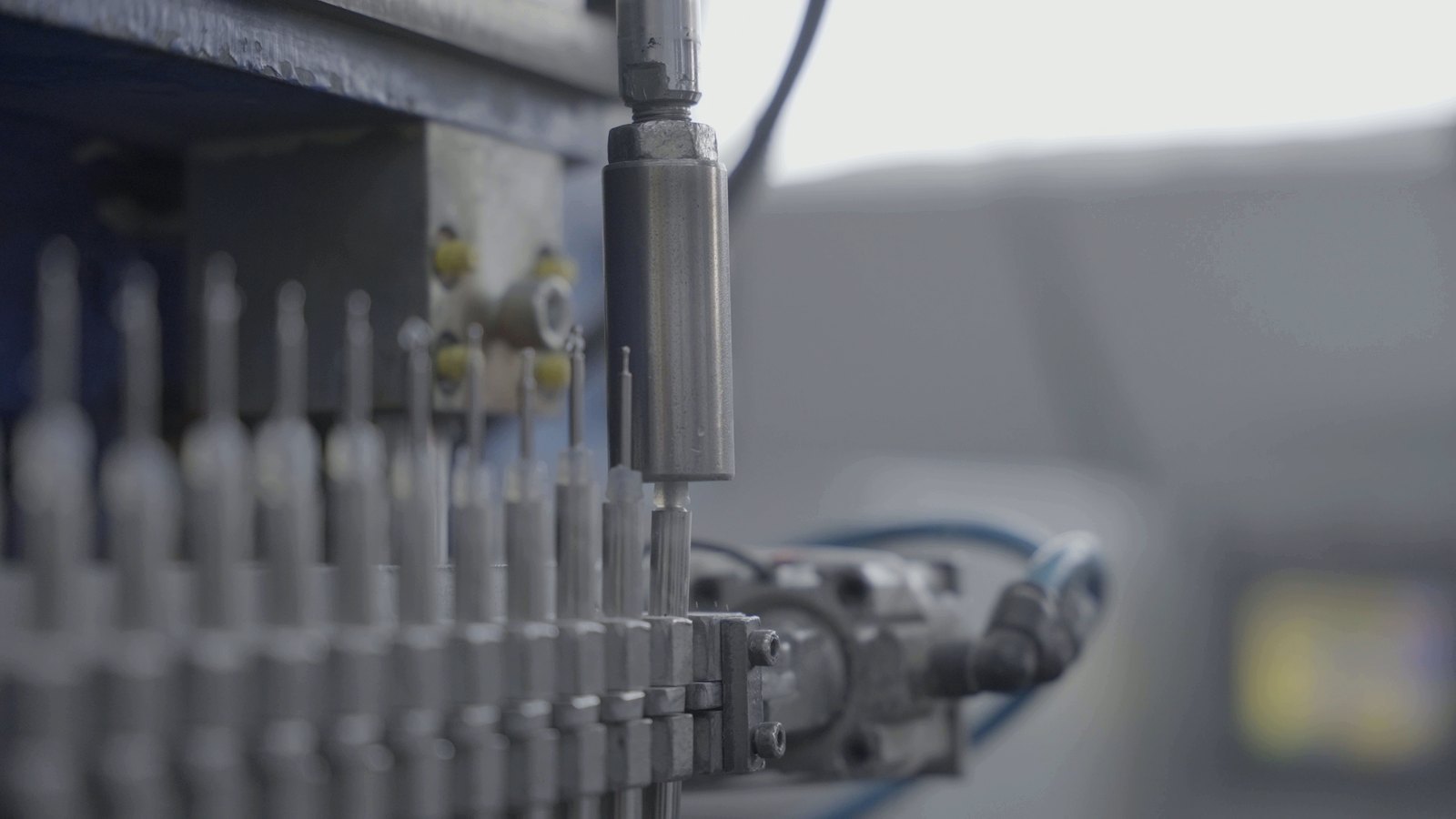 Closed after MgO filling
Why it matters
MgO is hygroscopic – a weak seal shows up as falling megaohms.
When moisture migrates into the powder around the terminal pin, insulation resistance between pin and sheath falls and leakage current rises. The seal has to stay tight through storage, transport, on/off cycling and the humidity inside the appliance.
- Insulation resistance test
- 500 V DC, terminals to sheath
- Dry, well-sealed element
- far above 100 MΩ
- Common component acceptance limit
- ≥ 5 MΩ
- Leakage current, hot
- measured at 1.15 × rated power input
- Limit, stationary class I heating appliances
- 0.75 mA or 0.75 mA per kW, whichever is greater, max. 5 mA
Leakage-current conditions and limits per EN 60335-1; the 5 MΩ value is an industry acceptance limit, not a standard requirement; project limits are agreed on the drawing.
What a leaking seal causes
- Low insulation readings at your incoming inspection after storage or sea freight.
- RCD trips at the first switch-on of the finished appliance.
- Leakage current above the limit in the hot test of the appliance.
- Early failures where the terminal end runs hot and humid at the same time.
How it works
More than one barrier between pin and sheath.
Instead of a single resin fill or a single bead, STF places more than one barrier in the moisture path – so the end stays tight while it heats and cools in service.
Sealing options
How STF compares with resin and bead seals.
Every seal has a temperature range and a moisture behaviour. The right one depends on how hot and how humid the terminal end gets in your appliance.
| Seal | Terminal-end temperature | Moisture barrier | Typical use |
|---|---|---|---|
| Silicone resin | ≈ 180 °C continuous | Good electrical insulation; limited life where the end runs hot | Washing machines, small appliances, water heaters, finned elements |
| Epoxy resin | ≈ 130 – 150 °C | Hard and robust; an excellent barrier at moderate temperature | Water heaters, washing machines, moisture-critical defrost heaters |
| PTFE bead | ≈ 260 °C | Chemically inert; often combined with a secondary resin against moisture | Ovens, small appliances, professional kitchen |
| Ceramic bead with cement | above 400 °C | For ends inside hot zones; weaker against moisture, so cold zones are made long | Radiant ovens and grills, sauna heaters |
| BALÇIK TORMEC STF | up to 240 °C continuous at the terminal end – confirmed per design | More than one barrier; designed for stable insulation resistance and leakage current through humidity storage and on/off cycling | Steam ovens, washing machines, water heaters in humid installations, professional kitchen steam equipment |
Typical continuous terminal-end temperatures for the grades we use – limits vary by grade (standard epoxies ≈ 90 °C). Qualitative comparison; the seal is confirmed with the drawing.
Where it is used
Wherever heat and humidity meet at the terminal end.
STF is listed as a sealing option in five of our product groups – the four below and other industrial appliances.
Steam and humid-cavity ovens
Terminal ends behind the cavity wall see heat and steam at the same time.
Washing machines
Alongside silicone and epoxy resin, for elements in a humid tub area.
Water heaters
For storage and immersion heaters in high-humidity installations.
Professional kitchens
Combi ovens and steam generators, where the terminal end sits in a steam environment.
Specify STF when
- the terminal end is exposed to heat and humidity at the same time;
- the appliance is tested under humidity storage or damp-heat conditions;
- elements are stored or shipped for long periods before first use;
- an existing seal has caused low insulation readings or RCD trips.
Test plan
Measured dry, stored humid, measured again.
A seal proves itself after humidity storage, not before it. That is the reading we compare.
- Every element: insulation resistance at 500 V DC and a high-voltage dielectric test before packing.
- Humidity storage on samples, then insulation resistance and leakage current measured again.
- Life test with on/off cycling, followed by an electrical re-test.
- Hot leakage current at 1.15 × rated power input – on samples and at type approval.
- Bead and seal inspection of the sealed end.
Test reports for your design come with the sample documentation. The full test programme is on the quality page.
Low insulation readings or RCD trips in the field?
Send the drawing and a description of the failure. We check seal, cold zones and terminal-end temperature and propose the sealing that fits.