

FAQ
Short answers to the questions every OEM project starts with.
These are the questions our sales engineers hear most often, answered briefly and factually. Where a value depends on your application, we say so – and point to the page or the person with the project-specific number.
Twenty-one answers in five groups: design, materials, approvals, ordering and logistics.
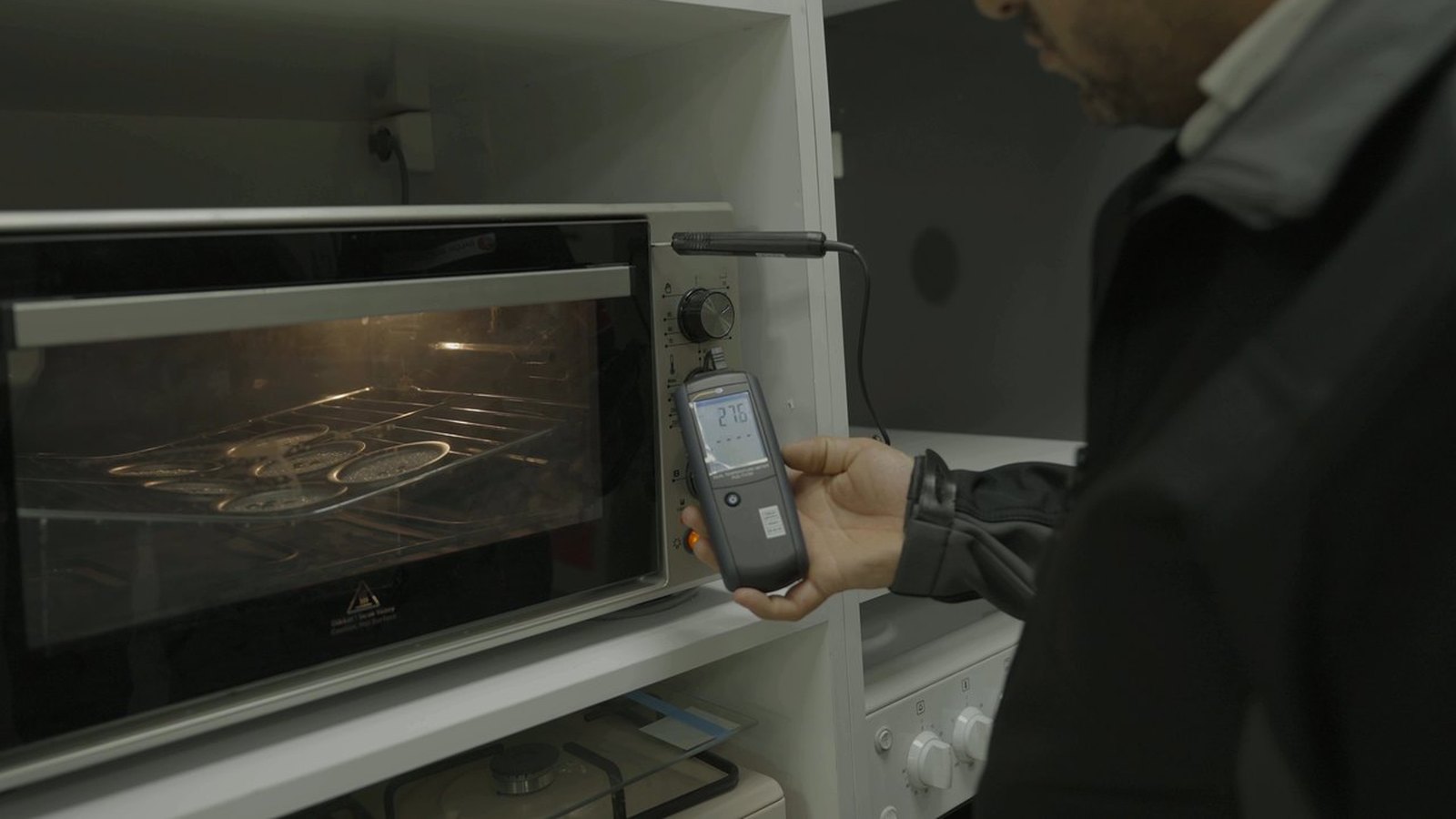 Validation laboratory
Design and specification
What we need – and what we design for you.
What information do you need to quote a tubular heating element?
Ten items: application and medium, rated voltage and connection, rated power and power tolerance, sheath diameter, developed length or a dimensioned drawing, cold zones, terminals, sealing, mounting and the approvals required. Annual quantity and target sample date complete the request – the design parameters page lists everything on one sheet.
If you only have an existing part, send it. We measure it for your drawing, but still ask about the application: the part shows what was made, not what the appliance needs.
What watt density should I use?
It depends on how fast the medium carries heat away from the sheath. Typical values on the heated sheath: ovens 5 – 8 W/cm² (up to ≈ 10 W/cm² on fan-oven rings behind a cover), washing machines 5 – 10 W/cm² on double hairpins (single hairpins run higher), storage water heaters 6 – 12 W/cm², instantaneous heaters 12 – 25 W/cm², frying oil 3 – 5 W/cm², still air 2 – 4 W/cm², forced air 3 – 6 W/cm² and defrost 1 – 3 W/cm².
In hard water, stay at the low end. The right load depends on medium, flow and allowed sheath temperature, so the final value is validated in our laboratory; the design guide lists all product groups and the calculator checks your geometry.
Can you design the element for us, or do we need a drawing?
Either. Most projects start from a space envelope, a power target and the medium; our engineering team proposes geometry, diameter, sheath material, cold zones and fittings, and returns a drawing for your approval. If you already have a drawing, we review it against watt-density and material rules before quoting – see the co-design process.
Can a thermal fuse, sensor or thermostat be integrated into the element?
Yes. Washing-machine elements are available with an integrated Thermofuse thermal fuse – single or double, preferred cut-out 144 °C or 152 °C, other values on request – and with NTC sensors. NTC or PT100 sensors can be fitted to the flange or clipped to the sheath, and storage water-heater elements are combined with our BALÇIK TORMEC stem thermostats, including models with safety cut-out.
State the trip temperature, sensor type and connector family on the drawing or in the RFQ.
Materials and lifetime
Choose the alloy for the water – and the seal for the end.
Which sheath material should I choose for water?
Clean or softened water: copper, tinned or nickel-plated, or AISI 304. Tap water with chlorides and detergent: AISI 316L or nickel-diffusion coated 304. Hard water: coated sheath or Incoloy® 825; brackish water: Incoloy® 825; Incoloy® 800 where a high load meets clean water.
Titanium is available on request for water heating only, such as seawater and chlorinated pool water. The design guide gives temperature limits and corrosion notes for each grade.
How long does a tubular heating element last?
Life is set by the coil temperature – which follows from watt density, medium and scale – and by the integrity of the terminal seal. Correctly specified elements are designed to outlast the appliance: the life target is agreed per project and verified by life tests.
Elements run above their watt-density range, in harder water than specified or with a seal unsuited to the terminal-end temperature fail earlier. We verify life with life tests – and pyrolysis life tests for self-cleaning ovens – in our validation laboratory.
What is the difference between nickel diffusion coating and a 316L or Incoloy sheath?
Nickel diffusion coating is a surface treatment: an electroless nickel layer is diffused into the outer layer of a stainless sheath, giving a corrosion- and scale-resistant surface at a cost well below an Incoloy® 825 tube. A 316L or Incoloy® sheath changes the bulk alloy and is chosen when the whole tube, including bends and brazed joints, must resist the medium. See nickel diffusion coating.
Why does the terminal end matter so much, and what is STF sealing?
MgO is hygroscopic. Moisture entering at the terminal end lowers insulation resistance and raises leakage current – the most common cause of field returns on tubular elements – so the seal must stay tight through storage, thermal cycling, humidity and vibration.
STF is BALÇIK TORMEC's multi-barrier terminal sealing for ends that are hot and humid at the same time; see STF sealing technology.
Certification and compliance
What we hold – and what is obtained per project.
Which certificates and approvals does BALÇIK TORMEC hold?
Our quality management system has been ISO 9001 certified since 2001; the current ISO 9001:2015 certificate was issued by Bureau Veritas in 2026. VDE approvals since 2000 – and since 2009 our certified heating-element families have carried VDE Marks Approvals, now renewed to DIN EN 60335-1 (VDE 0700-1):2024-07.
Certificate numbers, validity and verification links are on the certificates page; the PDFs are in the download centre.
Which approval marks do your elements carry as components?
Our certified element families carry VDE marks approvals as components under EN 60335-1. For any further marks your appliance needs, we provide the test data and construction files the test house needs.
Whether a new design is covered by an existing approval or needs an extension depends on its construction. State the mark you need in the RFQ and we confirm the route.
Are your products RoHS and REACH compliant?
Our tubular heating elements are covered by two manufacturer’s declarations. Our RoHS declaration under Directive 2011/65/EU as amended by (EU) 2015/863 is dated 16 March 2026 and based on Intertek test reports. Our REACH declaration rests on an SVHC screening of nine component materials in November 2025: no SVHC above 0.1 % by weight.
Both declarations are in Turkish and can be downloaded from the download centre; English wording and customer-specific declarations on request.
Can you supply CO₂ or carbon-footprint data for supplier questionnaires?
Yes – a statement on our energy sources, including the 750 kWe AC / 1 MWp DC rooftop solar plant (about 1.2 GWh and 540 t CO₂ avoided per year), and a CBAM and product-carbon-footprint data-readiness statement for EU customers. Ask your sales contact for the current status of our carbon-footprint reporting; background is on the sustainability page.
Ordering and samples
Clear minimums, samples typically within a week.
What is your minimum order quantity?
Our minimum order is 500 pcs for Ø6.5 mm and 250 pcs for Ø8.5 mm elements. OEM series programmes are quoted per project: tooling and set-up are spread over the forecast annual volume, and the quotation states the price breaks. Single pieces and small quantities for customers in Türkiye are available from our online shop, balcikrezistans.com.
How long does it take to get samples?
Prototypes and samples typically within 1 week, and quotations within 1 week, when the required accessory components (terminals, flanges, thermostats) are available. New bending tools, special flanges or new sealing configurations take longer; the quotation states the project date.
Samples come with an initial sample inspection report and, where agreed, material certificates.
What are series lead times?
Series lead times are confirmed per project in the quotation and depend on construction, fittings and the raw-material position. Running products usually work on rolling forecasts with scheduled call-offs, which shortens the effective lead time to the agreed delivery cycle.
Which quality documents do you provide at sample and series stage?
At sample stage: ISIR or PPAP-style documentation at the agreed level, a dimensional report, electrical test results – resistance, dielectric strength, insulation resistance, leakage current – material certificates on request and RoHS and REACH declarations.
In series: a certificate of conformity per delivery and, on request, lot-based electrical test records, traceable to the raw-material lot. See quality.
What warranty do you give?
All BALÇIK TORMEC products carry a 2-year warranty against manufacturing defects, from the date of delivery. Claims are handled by our quality team; an 8D report is available on request. See quality.
Logistics and packaging
Packed for the line it feeds.
How are heating elements packed for shipment?
In corrugated cartons with separators or moulded trays, sized to protect bent geometries and terminals, then palletised and stretch-wrapped for export. Returnable trays or packaging for automated assembly lines are set up per project, and labels – part number, lot, quantity, barcode or QR code – follow your specification.
Do you ship worldwide, and which Incoterms do you use?
Yes – to more than 60 countries on five continents from our own warehouse in Kahramankazan, Ankara: by road to Europe, by sea or air elsewhere. EXW, FCA, CPT and DAP are the most common Incoterms; others can be agreed.
Our export team (exp@tormec.com.tr) prepares the documents, including A.TR movement certificates for the EU customs union and EUR.1 / EUR-MED or origin declarations for free-trade partners such as the UK and the EFTA states.
Can you hold stock or deliver on a call-off schedule?
Yes. For running series we work with rolling forecasts and scheduled call-offs, and for selected customers we hold agreed safety stock of finished elements or semi-finished tubes. Terms are set in the supply contract.
How should heating elements be stored before assembly?
Dry, indoors and in the original packaging at normal ambient temperature: MgO is hygroscopic, so keep terminal seals away from humidity and condensation. For long storage or sea freight, specify STF sealing.
After long storage in uncertain conditions, measure insulation resistance – in MΩ, at 500 V DC – before assembly; a value far below the acceptance level points to moisture.
Question not answered here?
Send it with your drawing or application data. We confirm receipt, and the responsible engineer or sales manager answers as soon as the technical details are clear.