

Design guide
Ten values decide whether an element outlives the appliance.
A tubular heating element is specified by about ten numbers and a handful of choices. Get them right on the drawing and the element runs for the life of the appliance; get one wrong and a specification problem turns into a field failure.
Three decisions sit behind most field failures – all of them visible on the drawing before a single part is made:
- Watt density: chosen for clean water, then run in calcium-rich water.
- Sheath: AISI 304 where the chloride level called for 316L or an Incoloy® grade.
- Terminal seal: passed the first dielectric test, then let in moisture after a few hundred thermal cycles.
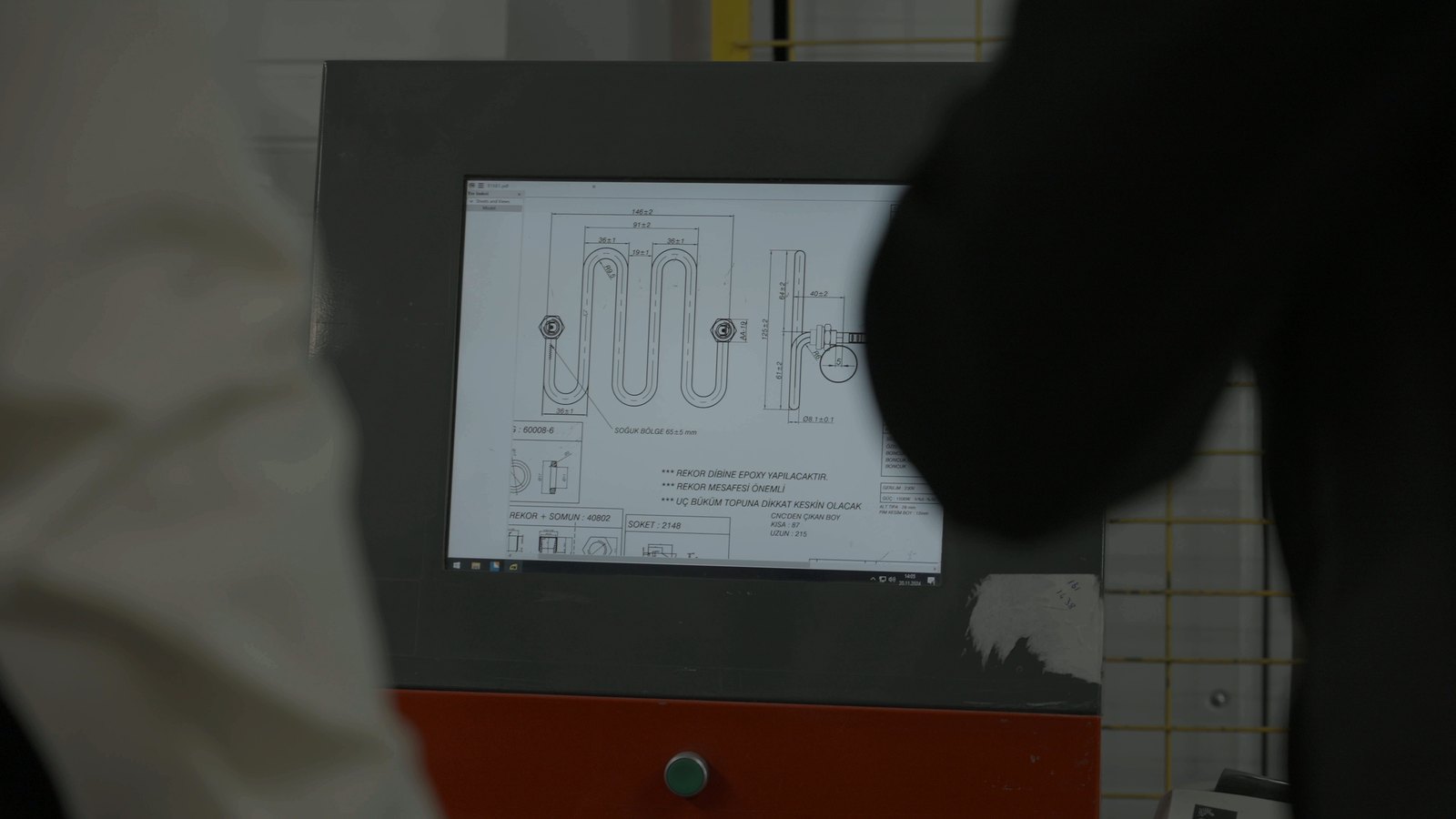 Drawing review
Anatomy
Seven parts, three lengths, one surface load.
Only the heated length releases heat. Watt density – the figure that best predicts life – is the rated power divided by the surface of the heated sheath.
Specification
Ten parameters, in the order they constrain the design.
An existing part number shows what was made, not what your appliance needs. These are the values we ask for; the one-sheet version is on the design parameters page.
Application and medium
What is heated and how it moves: still or flowing water, hardness (above about 15 °dH counts as hard), detergent, chlorides; air velocity; bare or covered in an oven.
Rated voltage
Supply, phases and connection – single, series, star or delta. 230 V and 400 V in Europe, 100 – 480 V for other markets; state any dual rating.
Rated power and tolerance
Power at rated voltage, per element and per circuit. Default power tolerance +5 % / −10 % (EN 60335-1); ±5 % on request.
Sheath diameter
6.0 – 16 mm in series; most common 6.5, 8.0, 8.5, 10, 12, 13.5 and 16 mm. Sets the surface per metre, the bend radius (typically 1.0 – 1.5 × d on the centreline) and the pin size.
Developed length
Total sheath length before bending, measured along the centreline. If you only have the bent form, send the drawing – we calculate it.
Cold zones
Unheated ends with a solid pin: minimum about 25 – 30 mm, typically 30 – 60 mm, 80 – 150 mm through flanges and walls. Asymmetric zones are normal.
Terminals
M4 – M6 studs, 6.3 or 4.8 mm flat tabs, screw-on ceramic sockets or lead wires. Name the connector family and the creepage distance you need.
Sealing
Silicone or epoxy resin, PTFE/PFA bead, ceramic bead or STF. State the maximum terminal-end temperature and any damp-heat test.
Mounting
Nipples G ½″ – G 2″ (BSPP, ISO 228-1) or NPT, round flanges Ø 48 – Ø 180 mm, washing-machine flanges with clamp bolt, welded brackets.
Approvals and documents
Marks the appliance carries, element-level VDE approval yes or no, ISIR or PPAP level, material certificates, RoHS and REACH.
Watt density
The medium sets the load – not the catalogue.
Watt density on the heated sheath fixes the temperature step between coil and medium. The same 2000 W coil can run for years in flowing water or burn out in minutes in still air.
| Medium and duty | Watt density on the heated sheath | Product group | Design note |
|---|---|---|---|
| Still water | 6 – 12 W/cm² storage heaters (lower in hard water) · 8 – 12 W/cm² kettles, boilers and bains-marie · 8 – 15 W/cm² industrial immersion | Water heating · small home appliances · professional kitchen | Higher loads speed up scale and local boiling at the sheath; thermostat and dry-run protection assumed. |
| Flowing water | 12 – 20 W/cm² steam generators and flow heaters · 12 – 25 W/cm² instantaneous heaters | Professional kitchen · water heating | Depends on velocity across the sheath; above 20 W/cm² only with clean water, a flow switch and an Incoloy® 800 sheath. |
| Wash water with detergent | 5 – 10 W/cm² on double hairpins; compact single hairpins run higher (hard water at the low end) | Washing machines | Scale insulates the sheath and chlorides pit plain 304: nickel-diffusion coated 304, 316L or Incoloy® 825. |
| Process water | 8 – 15 W/cm² | Other industrial | Process chemistry decides the sheath – AISI 316L for process liquids. |
| Frying oil | 3 – 5 W/cm² | Professional kitchen | Convection only; no dead pockets where fat can carbonise. |
| Food contact | 6 – 8 W/cm² | Professional kitchen | Hygiene and aggressive cleaning agents decide the sheath and the joints. |
| Still air | 2 – 4 W/cm² (sauna at the upper end) | Other industrial | Sheath at 350 – 550 °C at the upper end; AISI 321 or Incoloy® 800 above 400 °C. |
| Forced air | 3 – 6 W/cm² | Other industrial | Scales with air velocity; interlock the element with the fan. |
| Air, finned element | 2 – 4 W/cm² on the tube | Finned elements | At the same load the fins keep the sheath far cooler than a bare tube. |
| Defrost | 1 – 3 W/cm² | Defrost elements | Low load avoids hot spots on refrigerant tubing; ends sealed against meltwater. |
| Radiant, in an oven cavity | 5 – 8 W/cm² (radiant duty) · up to ≈ 10 W/cm² on fan-oven rings behind a cover | Ovens · small home appliances (radiant 5 – 8 W/cm²) | Sheath at 650 – 800 °C, visible red; AISI 321 up to ≈ 750 °C, Incoloy® 800 above. |
| Metal contact | 3 – 6 W/cm² clamped or cast-in metal contact · 3 – 9 W/cm² cast-in or clamped to aluminium | Other industrial · small home appliances | Contact quality decides: a 0.1 mm air gap can double the sheath temperature; cast-in aluminium tolerates the most. |
| Straight rods | Per application medium | Straight rod elements | Supplied in cut lengths with cold ends; the medium of the final assembly sets the load. |
Values from the specifications by product group – the master table for every page of this site. The right surface load depends on the medium, flow and allowed sheath temperature; the final value is validated in our laboratory. Media not listed – thermal oil, glycol mixtures, chemicals – are rated per project.
Materials and terminations
The sheath carries two duties – heat and corrosion.
In air the alloy's temperature limit decides; in liquids the medium sets the temperature and corrosion decides. The terminal end is where moisture gets in.
Sheath materials
| Material | Max. continuous sheath temperature (typical) | Suitable media | Notes |
|---|---|---|---|
| AISI 304 (1.4301) | ≈ 650 °C | Clean and softened water, air, oils, most food media | General-purpose grade. Chloride pitting and stress-corrosion risk in hot water with chlorides or detergent – coated for washing machines. |
| AISI 316L (1.4404) | ≈ 650 °C | Tap water with chlorides, detergent solutions, demineralised water, food media | Molybdenum-bearing; PREN ≈ 24 against ≈ 18 for 304. Common for washing machines and process liquids. |
| AISI 321 (1.4541) | ≈ 750 °C | Air, radiant oven duty, dry heat | Titanium-stabilised against intergranular attack in the 450 – 800 °C range; common oven sheath where Incoloy® is not required. |
| Incoloy® 800 (1.4876) | ≈ 850 °C | Oven and grill elements, fan-oven rings, sauna, fryers, high load in clean water | Nickel–iron–chromium alloy with high oxidation resistance and strength at red heat. |
| Incoloy® 825 (2.4858) | ≈ 550 °C (corrosion duty) | Hard, aggressive and brackish water, acidic cleaning media | Nickel against chloride stress-corrosion cracking, molybdenum against pitting and crevice corrosion, titanium against intergranular attack; hard-water heaters, boilers and premium washing machines. |
| Copper, tinned or nickel-plated | ≈ 180 °C | Clean potable water, cast-in kettle bases, defrost | Best heat transfer and lowest wire temperature; vulnerable to ammonia, sulphides and aggressive water. |
| Nickel-diffusion coated stainless | As the base grade | Hard, chloride- or detergent-bearing water | A diffused surface layer, not a new alloy – a lower-cost option to Incoloy® 825. See nickel diffusion coating. |
| Titanium, Grade 2 – on request, water heating only | ≈ 300 °C in liquids | Seawater, chlorinated pool water | Virtually immune to chloride attack; hard to braze, so fittings are welded or mechanical. |
Sheath-surface temperatures for normal appliance life in air; short excursions above are acceptable. For media not listed, send us the full chemistry and temperature.
Terminals and seals
| Option | Typical use | Terminal-end temperature | Notes |
|---|---|---|---|
| Threaded stud M4 / M5 / M6 with nut and washer | Water heaters, professional kitchen, industrial | Up to ≈ 250 °C at the stud | Most robust; ring or fork terminals; torque on the drawing, typically 1.5 – 3.5 N·m. |
| Flat tab 6.3 × 0.8 mm or 4.8 mm, welded or crimped | Washing machines, ovens, small appliances, water heaters | Up to ≈ 150 °C tin-plated, ≈ 250 °C nickel-plated | Fast harness assembly; locking lance available; orientation dimensioned. |
| Screw-on ceramic terminal socket | Ovens, grills | Up to ≈ 300 °C | Insulated, finger-safe, keyed against cross-wiring. |
| Lead wires – silicone, PTFE or fibreglass insulated | Small appliances, defrost heaters, compact units | 180 or 250 °C, by insulation | Length, colour code and connector to your specification. |
| Silicone resin seal | General appliances, washing machines | ≈ 180 °C continuous | Economical, good insulation; limited life on hot ends. |
| Epoxy resin seal | Water heaters, defrost, industrial | ≈ 130 – 150 °C | Hard, robust moisture barrier at moderate temperature. |
| PTFE / PFA bead | Ovens, small appliances | ≈ 260 °C | Chemically inert; often combined with a secondary resin barrier. |
| Ceramic bead with high-temperature cement | Radiant ovens, grills, sauna | Above 400 °C | For ends inside hot zones; a weaker moisture barrier, so cold zones are made long. |
| STF seal | Steam ovens, washing machines, water heaters, humid installations | Hot and humid ends | Balçık's multi-barrier seal for stable insulation resistance and leakage current. See STF sealing. |
Tolerances and tests
The values we hold – and test before packing.
Every element passes a high-voltage dielectric test, an insulation-resistance test and a resistance or power check, plus visual and dimensional checks. Leakage current and high-voltage tests at operating temperature run on samples and at type approval.
| Characteristic | Standard value | Basis and remarks |
|---|---|---|
| Power tolerance (heating appliances above 200 W) | +5 % (or +20 W if greater) / −10 % of rated power input at rated voltage, measured hot | EN 60335-1, clause 10.1; ±5 % on request. |
| Resistance check, cold | Nominal R = U² / P; acceptance window derived from the power tolerance | NiCr 80/20 wire reads typically 2 – 5 % below its hot value, so a cold reading slightly under U² / P is normal. |
| Dielectric strength, routine | 1250 V AC, 50 Hz, 1 s on every element | Terminals connected together against the sheath; no breakdown. |
| Dielectric strength, type test | 1250 V AC for 1 min, basic insulation, class I | EN 60335-1, clause 16.3. |
| Insulation resistance, cold | Per drawing at 500 V DC; dry elements typically far above 100 MΩ | Indicator of MgO dryness and seal integrity; re-measured after humidity storage on samples. |
| Leakage current, hot | Stationary class I heating appliances: 0.75 mA or 0.75 mA per kW of rated power input, whichever is greater – maximum 5 mA | EN 60335-1, 13.1 and 13.2: measured at operating temperature with the appliance supplied at 1.15 × rated power input. Element share agreed per project, e.g. ≤ 0.25 mA/kW at sample stage. |
| Developed length and bends | ±2 mm up to 1000 mm; bend positions ±1.5 mm; angles ±2° | Tighter for automated assembly – state it on the drawing. |
| Sheath diameter | Tube tolerance, typically ±0.05 mm | Set by roll reduction in our plant. |
| Cold-zone length | ±5 mm typical, ±3 mm on request | Checked by cold-zone verification in our laboratory. |
Clause references for orientation. The part-2 standard of the appliance – e.g. EN 60335-2-6 ovens, 2-7 washing machines, 2-21 storage and 2-35 instantaneous water heaters – may modify the values, and tighter customer values can be agreed.
Put the numbers on a drawing.
Configure the element online or send your drawing. Our engineering team checks surface load, materials and terminations before it quotes – and proposes changes where they extend element life.