

Glossary
One vocabulary for drawings, test reports and approvals.
Heating-element specifications mix mechanical, electrical and materials terms. This glossary defines 46 of them the way they are used on Balçık drawings and in the standards we design and test to.
Typical values are given where they help; values per product group are in the specifications by product group.
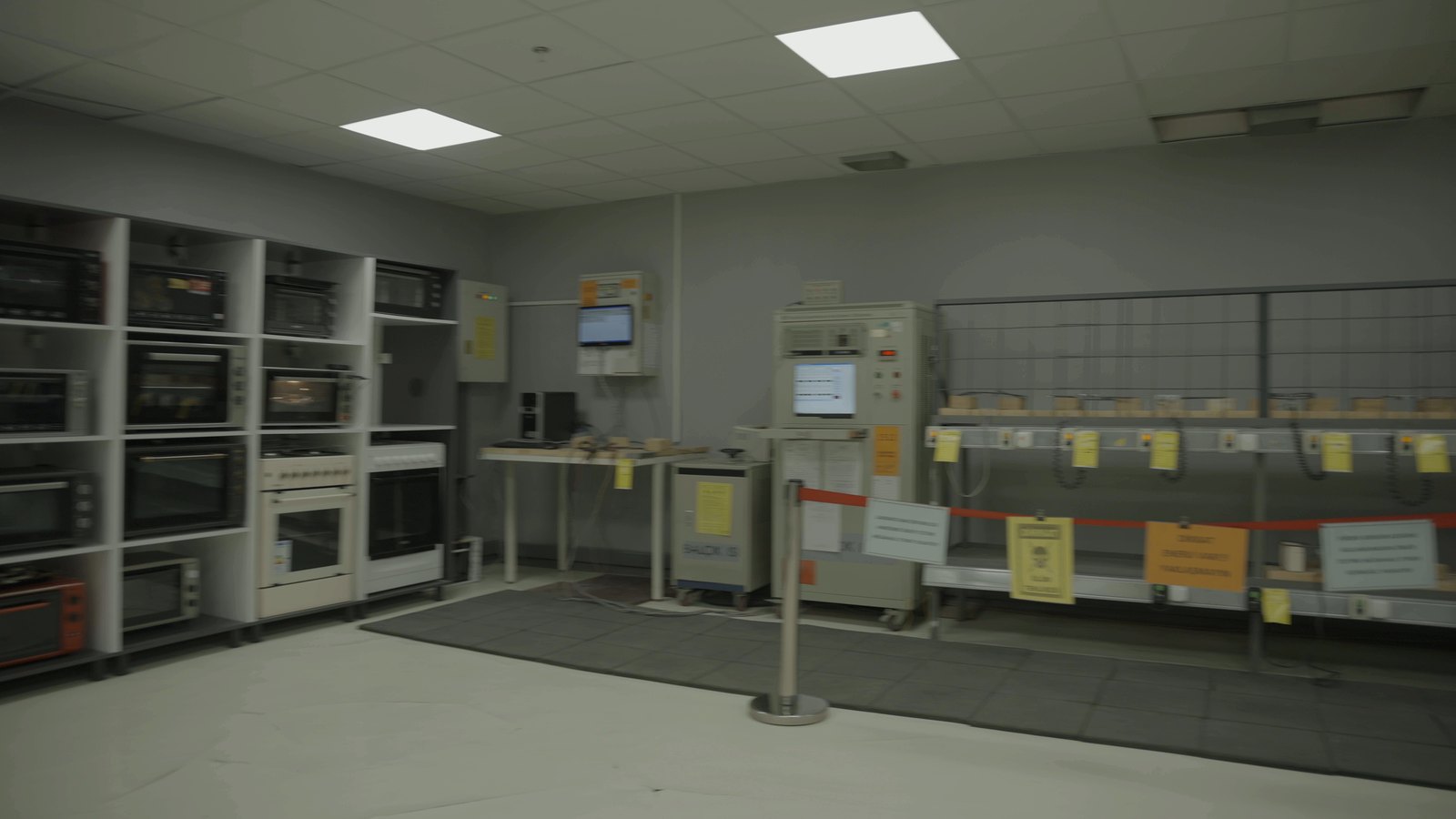 Validation laboratory
A – W
46 terms, each defined in a line or two.
Open a term for its definition. Synonyms come first; links lead to the page that covers the topic in depth.
A
AISI 304 / 316L / 321
EN 1.4301 / 1.4404 / 1.4541. Austenitic stainless steels for sheaths: 304 for general purposes, 316L with molybdenum for chloride and detergent resistance, 321 titanium-stabilised for oven and air duty up to about 750 °C sheath temperature.
Annealing
Heat treatment after rolling that lowers hardness and residual stress and restores ductility, so the tube can be bent without cracking. It does not make the tube stronger. The heat also drives residual moisture out of the MgO.
B
Brazing
Joining flanges, nipples and brackets to the sheath with a copper-, silver- or nickel-based filler below the melting point of the parent metals – in a furnace under protective atmosphere or with a flame. The joint must be leak-tight to the test pressure on the drawing.
Bright annealing
Annealing under a protective, hydrogen-containing atmosphere: the stainless surface stays bright and oxide-free, needs no pickling and is ready for brazing. See bright annealing technology.
C
CE marking
The appliance manufacturer's declaration that the finished appliance meets the applicable EU directives. It is not a certificate and applies to the appliance, not to the element; Balçık supplies declarations and technical documentation for the OEM's file.
Cold resistance
Resistance of the element at room temperature. Resistance wire has a positive temperature coefficient, so NiCr wire reads typically 2 – 5 % below the hot value that defines rated power. Checked on every element.
Cold zone
Also: inactive length, unheated end. The end length where a solid terminal pin replaces the coil, so no heat is generated there. Keeps terminal, seal and mounting cool: typically 30 – 60 mm, 80 – 150 mm through flanges; minimum about 25 – 30 mm.
Compaction
Also: rolling, reduction. Reducing the filled tube in diameter until the MgO forms a dense, thermally conductive and electrically insulating mass around the coil. Balçık compacts by rolling; the diameter reduction is typically 10 – 20 %.
Creepage distance
Shortest path along an insulating surface between two conductive parts – for example from terminal pin to sheath across the seal. Minimum values are set in EN 60335-1, clause 29.
D
Developed length
Also: straight length. Total sheath length end to end before bending, measured along the centreline. With diameter and cold zones it fixes the heated surface – and so the watt density.
Dielectric strength
Also: high-voltage test, hipot. Ability of the insulation between live parts and sheath to withstand a test voltage without breakdown. Routine test on every element: 1250 V AC for 1 s, above the 1000 V routine value of EN 60335-1, Annex A; type test 1250 V for 1 min (EN 60335-1, clause 16.3).
Dry running
Also: dry firing. Operating an immersion element without its medium. The sheath overheats rapidly, so the appliance prevents it with a level or flow switch, a thermostat or a thermal fuse.
E
EN 60335-1
Also: IEC 60335-1, DIN EN 60335-1 / VDE 0700-1. General safety standard for household and similar electrical appliances – power tolerance, leakage current, dielectric strength, temperature limits, creepage. Part 2 standards add rules per appliance, e.g. 2-6 ovens, 2-7 washing machines, 2-21 storage and 2-35 instantaneous water heaters.
ENEC
European mark issued by participating test houses, such as VDE or IMQ, for compliance with the applicable EN standard. For Balçık elements, ENEC is obtained per project with the customer on request.
F
Finned element
Tubular element with a helically wound aluminium, galvanised-steel or stainless fin that enlarges the air-side surface: a far lower sheath temperature at the same load, at 2 – 4 W/cm² on the tube.
Flange
Plate brazed or welded to the sheath and bolted into a tank or appliance wall with a gasket. Round flanges Ø 48 – Ø 180 mm (steel, enamelled or stainless) for water heaters; shaped rubber-gasketed flanges with a clamp bolt for washing machines.
H
Heated length
Also: active length. Developed length minus the cold zones – the part of the sheath that releases heat, and the length used to calculate watt density.
Hot resistance
Resistance of the element at operating temperature. Rated power is defined with it: P = U² / R(hot).
I
Incoloy® 800 / 825
EN 1.4876 / 2.4858. Nickel–iron–chromium sheath alloys. 800 for high temperature – oven and grill elements, sauna, fryers, high load in clean water; 825, with molybdenum and copper, for hard, aggressive and brackish water.
Insulation resistance
Resistance between live parts and sheath, measured with DC voltage – typically 500 V – and stated in megaohms (MΩ). A dry element reads far above 100 MΩ; the limit is set on the drawing. A falling value is the first sign of moisture in the MgO.
IP rating
EN 60529. Ingress protection code of an enclosure: first digit for solids, second for water – e.g. IPX4 splashing, IPX5 jets, IPX7 temporary immersion. Applies to terminal boxes and covers, not to the sheathed element.
ISIR
Initial sample inspection report. Delivered with first samples; records every drawing dimension and specified characteristic against measured values. From VDA Volume 2 and widely used by European appliance OEMs.
L
Leakage current
Current from live parts through the insulation to the earthed sheath in operation, measured at operating temperature with the appliance supplied at 1.15 × rated power input. EN 60335-1 limit for stationary class I heating appliances: 0.75 mA or 0.75 mA per kW, whichever is greater, maximum 5 mA.
M
MgO
Magnesium oxide. Electrically insulating, thermally conductive powder between coil and sheath, compacted by rolling; grain size and density are checked by sieve analysis and density tests. Hygroscopic – which is why the element ends are sealed.
MOQ
Minimum order quantity. For OEM series Balçık quotes per project with price breaks rather than one fixed MOQ.
N
Nickel diffusion coating
Surface treatment of stainless sheaths: an electroless nickel layer is diffused into the surface by heat treatment, giving a dense, scale- and corrosion-resistant layer. Applied by Balçık Brazing; a lower-cost option to Incoloy® 825 in hard water. See nickel diffusion coating.
Nipple
Also: threaded boss. Threaded fitting brazed to the sheaths, by which the element screws into a tank: G ½″ – G 2″ (BSPP, ISO 228-1) or NPT. Brass for domestic water heaters, stainless steel for professional and industrial use.
NTC sensor
Negative-temperature-coefficient thermistor used as temperature sensor in washing machines and water heaters, fitted at the flange; specified by its resistance at 25 °C – e.g. 4.7 kΩ or 10 kΩ – and its B-value.
P
Power tolerance
Permitted deviation of the measured power input from rated power. EN 60335-1, heating appliances above 200 W: +5 % (or +20 W if greater) / −10 %; 25 – 200 W: ±10 %; ±5 % on request. It is specified on power, not on resistance.
PPAP
Production part approval process. Structured approval package, levels 1 – 5, from the automotive industry and increasingly requested by appliance OEMs. Balçık supplies PPAP-style sample approval at the level agreed in the project.
PT100
Platinum resistance thermometer with 100 Ω at 0 °C (IEC 60751), classes A or B. Used where accuracy and long-term stability matter – professional kitchen and industrial elements.
PTFE / PFA bead
Fluoropolymer bead pressed into the tube end around the terminal pin as seal and spacer; serviceable to about 260 °C, chemically inert, often combined with a resin barrier.
R
Rated power
Also: nominal power. Power input at rated voltage and operating temperature, as marked on the element.
REACH
Regulation (EC) 1907/2006. EU chemicals regulation: for articles, any substance of very high concern (SVHC) above 0.1 % by weight must be declared. Balçık's REACH declaration, in Turkish, is in the download centre; customer-specific declarations on request.
Resistance wire
The coil alloy – NiCr or FeCrAl, chosen by temperature class and specified by resistivity, wire diameter and coil pitch.
RoHS
Directive 2011/65/EU, amended by (EU) 2015/863. Restricts ten substances – lead, mercury, cadmium, hexavalent chromium, PBB, PBDE and four phthalates – in electrical equipment. Balçık's RoHS declaration, in Turkish, is in the download centre.
S
Sheath
Also: tube, jacket. Outer metal tube in contact with the medium; it carries the corrosion and temperature duty. Diameters 6.0 – 16 mm, wall typically 0.5 – 1.0 mm; AISI 304, 316L, 321, Incoloy® 800 and 825, copper, nickel-diffusion coated stainless; titanium on request (water heating only).
Sheath temperature
Surface temperature of the sheath in operation; it decides oxidation, scale and life. Typically about 100 – 120 °C in water, 350 – 550 °C in still air and 650 – 800 °C for radiant oven elements.
Stem thermostat
Also: rod thermostat. Thermostat with a rigid sensing stem in a pocket next to the element, switching it directly – usually an adjustable regulating contact plus a separate safety cut-out. Made by Balçık under the Tormec brand; see stem-type thermostats.
STF sealing
Balçık's multi-barrier terminal sealing for ends that are hot and humid at the same time, designed to keep insulation resistance and leakage current stable through humidity storage and thermal cycling. See STF sealing technology.
T
Terminal pin
Also: cold pin. Solid conductor welded to the coil end, running through the cold zone and out of the sheath, where it carries the stud, tab or lead wire; typically nickel-plated steel or stainless, Ø 2 – 4 mm.
Thermal fuse
Also: thermal cut-off, Thermofuse. One-shot device that opens permanently above its rated temperature and protects the appliance if the element runs dry. Balçık's Thermofuse washing-machine elements carry a single or double fuse; preferred cut-out 144 °C or 152 °C, other values on request.
Tubular heating element
Also: sheathed element, Rohrheizkörper. Resistance coil embedded in compacted MgO inside a metal sheath, with terminal pins and sealed ends, bent to the shape the appliance needs.
U
UL / cUL
North American safety marks – UL for the United States, cUL for Canada – with standards such as UL 499 or UL 1030 for heaters. For Balçık elements they are obtained per project with the customer on request.
V
VDE
German testing and certification institute (VDE Prüf- und Zertifizierungsinstitut). Balçık holds VDE marks approvals to DIN EN 60335-1 (VDE 0700-1):2024-07 for its certified heating-element families; see certificates.
W
Watt density
Also: surface load. Power released per cm² of heated sheath: P / (π · d · Lh). The strongest single predictor of life; values per product group range from 1 – 3 W/cm² (defrost) to 12 – 25 W/cm² (instantaneous water heaters). See the design guide.
Units and symbols
How values are written on our drawings.
SI units with a space before the unit; watt density always on the heated sheath; insulation resistance always in megaohms.
| Symbol | Meaning | Unit and example |
|---|---|---|
| P | Rated power input | W, kW – e.g. 2000 W |
| U | Rated voltage | V – e.g. 230 V, 400 V three phase |
| R | Resistance, hot or cold | Ω – nominal R = U² / P |
| d | Sheath diameter | mm – e.g. Ø 8.0 mm |
| L, Lh, c₁, c₂ | Developed length, heated length, cold zones | mm – L = c₁ + Lh + c₂ |
| P / (π · d · Lh) | Watt density on the heated sheath | W/cm² – with d and Lh in cm |
| I | Leakage current | mA – measured at 1.15 × rated power input |
| R(iso) | Insulation resistance | MΩ – measured at 500 V DC |
| °dH | Water hardness, German degrees | Above about 15 °dH counts as hard water |
| G ½″ – G 2″ | Parallel pipe thread, BSPP (ISO 228-1) | Nipple threads; NPT for North America |
| M4 – M6 | Metric thread of terminal studs | Tightening torque stated on the drawing |
| IP54, IP65 | Ingress protection (EN 60529) | Terminal boxes and covers |
Missing a term?
Tell us which term you need – or send the drawing it appears on, and an engineer will explain it in context.